Showing posts with label Philippines. Show all posts

Tuesday, March 6, 2012

Birds of the Philippines: Philippine Eagle

Philippine eagle is known before as the monkey eating eagle.It belongs to kingdom Animalia, Phylum- Chordata, Class-Aves, Order-Falconiformes, Family-Accipitridae. Its scientific name is Pithecophaga jefferyi.

It is a giant forest raptor endemic to the Philippines. It has brown and white-coloured plumage, and a shaggy crest and generally measures 86 to 102 centimeters in length and weighs 4.7 to 8 kilograms.

Birds of the Philippines: Philippine Eagle
Philippine eagle is the rarest, largest and most powerful birds int he world. The IUCN red list categorized Philippine eagle as critically endangered. Philippine eagle is also the worlds rarest and certainely among its most critical endangered certebrate species. Due to massive loss of habitat due to deforestation in most of its range.

Philippine eagle are monogamous and they tend to bond for life. The Philippine Eagle Foundation based in Davao city. And is committed to promote the survival of the Philippine Eagle, the biodiversity it represents, and the sustainable use of our forest resources for future generations to enjoy.


Saturday, March 3, 2012

Spotted Dove (Stigmatopelia chinensis)

I was able to encounter these Philippine Bird species in our expedition in Andanan watershed, Agusan del sur last 2007. I hope i had then my slr canon camera to have a photograph of these species. These species belongs to the Kingdom- Animalia, Phylum-Chordata, Class-Aves, Order-Columbiformes, Family-Columbidae. With the scientific name of Stigmatopelia chinensis. It is also called Spotted Turtle Dove.

IUCN red list categorized these species as least concern (LC). These has a wide range not only in the Philippines. It inhabits Terrestrial and freshwater areas. Just like any other doves, it feeds on the seeds and fruits.

Monday, February 27, 2012

Pied Fantail (Rhiphidura javanica)

It belong to the Animal Kingdom, Phylum- Chordata, Class- Aves, Order-Passeriformes, Family- Rhipidura. Its scientific name is Rhipidura javanica with a common name of Pied Fantail. It is classified by IUCN as Least concern or its does not need immediate conservation intervention. So its is not threatened or endangered. Its is also not a Philippine Endemic.

This one of the common species of birds found in the Philippines. It has a wide range of population of Population and can also be seen in Darussalam, Cambodia, Indonesia, Malaysia, Myanmar, Philippines, Thailand.

It usually inhabits terrestrial areas. These photos was taken in a miniforest of MSU-Maguindanao. At around early morning.

These species love to fan out their long and beautiful tail. Their primary source of food is insects. They like to farage on the ground and catch insects.Their broadbill healps then catch insects even in the dark understory of the forest.

Friday, February 24, 2012

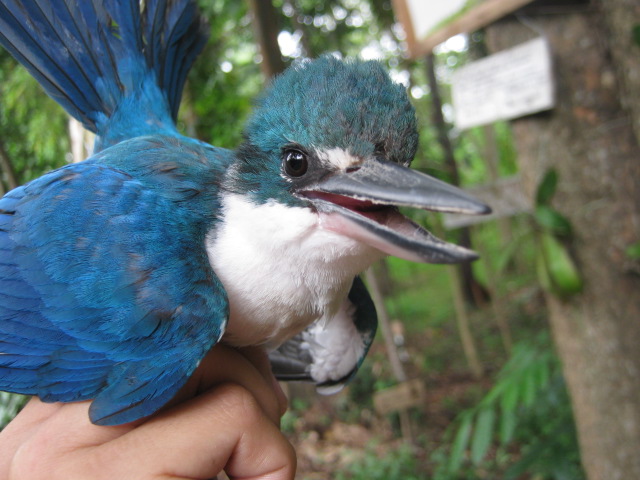
White-Collared Kingfisher (Todiramphus chloris)

These White-Collared Kingfisher is caught at the mini-forest of the College of Forestry and Environmental Studies at MSU-Maguindanao. It was caught early morning in the opening towards the mini-forest. In one of the laboratory activity we have with my student. We caught these Kingfisher using a mist nets.

These species are categorized by IUCN as least concern or they do not need an immediate attention for conservation. However, if their habitat destruction will continue to increase, definitely its population will decline also.

It belongs to Kingdom: Animalia; Phylum: Chordata; Class: Aves; Order: Coraciiformes; Family: Alcedinidae. It is also called Mangrove Kingfisher. It is not only found in the Philippines but although southeast Asia. These species can usually be seen along rivers, freshwater areas, and streams within the forests. It usually feeds on small crabs, insects, worms, snails,shrips, frogs, and lizards.